





The cost of streaming services continues to rise. This year, Netflix, Hulu, Disney Plus, ESPN Plus, and Apple TV Plus all announced pricing increases, which means we'll have to spend more money to stay up with series like Andor or Stranger Things.
The fact is that this tendency isn't going away anytime soon. If streaming services want to match investors' expectations, they either boost their pricing or accept advertising. They'll just have to risk losing users who don't want to pay these exorbitant costs along the road.
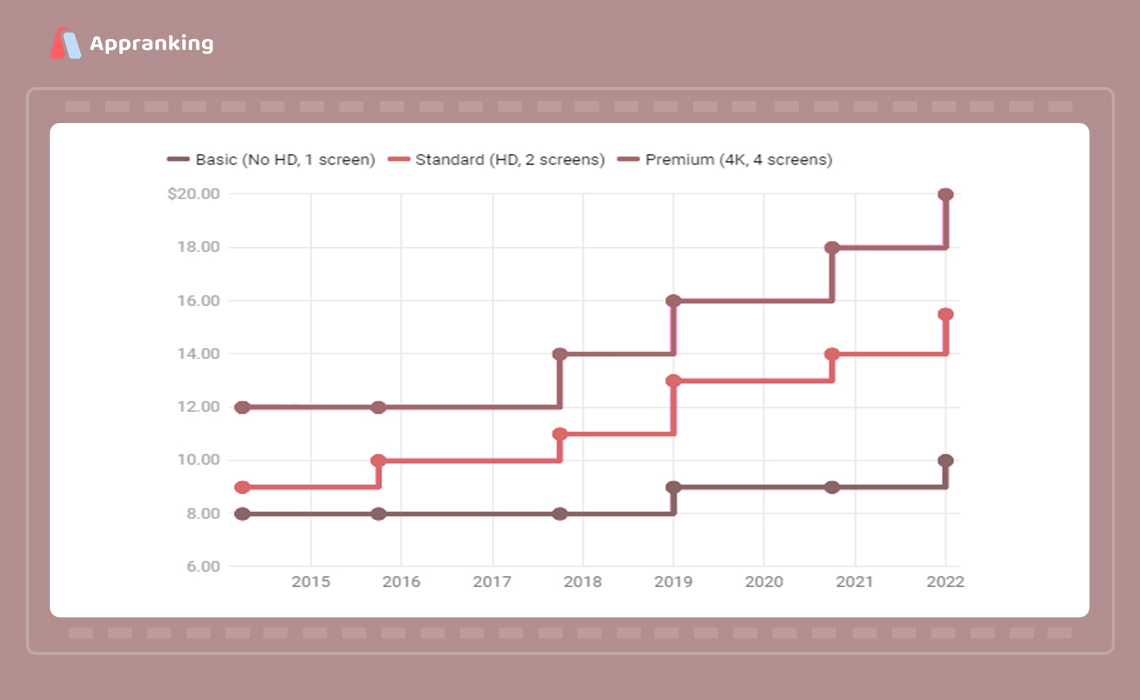
A normal Netflix subscription cost $7.99 per month in 2011, which is $1 higher than the ad-supported option Netflix released last week. Netflix released its $11.99 per month 4K premium membership in 2013, and things only grew more costly from there, with $1 or $2 price increases across all tiers over the following several years.
Netflix's most costly plan increased from $11.99 to $13.99 in 2017, while its ordinary plan increased from $9.99 to $10.99. The firm ascribed the increase at the time to the inclusion of additional unique content and services. However, this was not the end of Netflix's price increases: in 2019, the premium plan was raised to $15.99, the regular plan to $13.99, and the basic option was raised to $8.99 for the first time. Netflix upped the cost of its regular and premium plans by another $2 in 2020, and then raised them again earlier this year.
That's how we got here: paying $19.99 for a premium subscription, $15.49 for a regular subscription, or $9.99 for a basic subscription. However, Netflix is not alone. Hulu upped the price of its ad-supported subscription for the first time last year, while other providers, such as Disney Plus and Apple TV Plus (both of which debuted in 2019), have all raised their costs this year.
As streaming services invest more money in establishing a library of material, they aren't gaining as much from acquiring new members as the streaming environment matures and most users have committed to their preferred providers. According to Kantar, by December 2021, 85 percent of US homes will have subscribed to a streaming service. This figure climbed by only 2% year on year, leaving limited possibility for expansion.
"Streaming TV is in its adolescence right now," says Eric Schmitt, research director and analyst at Gartner. "The early days of the land grab are coming to an end." We're approaching the point where service providers must demonstrate to their investors that they have sustainable companies."
Furthermore, businesses like Netflix do not profit from licensing content to other platforms. Netflix's original material is unique to the service, and the company pays to acquire the rights to other studios' content for use on its platform. That's why the service acted after losing customers for the first time in more than a decade in April, followed by millions more in the months that followed. In order to diversify its revenue sources and pressure existing members, the firm has recently launched an ad-supported tier and plans to cut down on password sharing next year. It also imposed a $17 billion ceiling on content investment for 2023 and maybe the next several years.
Apple TV Plus is in the same boat as Netflix in that it only makes money by recruiting members, not by licensing out the content it spends money creating. Apple hiked rates for all of its services, including Apple TV Plus, last month, claiming "an increase in license costs." While the firm hasn't yet used advertising to help offset some of these costs, it's nearly certain that it will.
“I think ad-supported is an inevitable state for almost every service,” Schmitt says, It's worth mentioning that some viewers may bear commercials in exchange for a cheaper membership fee. There have been a few reports concerning Apple TV Plus adding advertisements, with a recent story from DigiDay stating that Apple has been in negotiations with media firms to introduce commercials to the service. According to Bloomberg, it is also apparently constructing an advertising network around its arrangement to stream Major League Soccer games.
Even if a streaming service makes some more money by licensing content to other platforms, this creates another issue that leads to price increases. Consider Disney, which utilizes a lot of its own content to build up the libraries of Disney Plus and Hulu.
Disney paid a $1 billion penalty earlier this year to terminate an undisclosed license arrangement and obtain the material on its own platform. While Disney did not specify the programming in issue, some speculate that it has to do with the business reacquiring Marvel episodes developed by Netflix in the mid-2010s, such as Jessica Jones and Daredevil, which are currently available on Disney Plus. Ending profitable arrangements like these (and not establishing them in the first place) forces Disney to raise prices to compensate for the loss.
While that's precisely what Disney did; starting in December, the price of Disney Plus will rise from $7.99 per month to $10.99 per month, and the ad-supported Hulu plan will rise from $6.99 per month to $7.99 per month, with the ad-free version rising from $12.99 per month to $14.99 per month. Even ESPN Plus's price increased in July, which explains why 40% of customers chose to purchase Disney's bundle, which includes all three services at a lower cost.
“The price of streaming services is reflective of the economic realities and costs that it takes to produce and distribute the content,” Schmitt says. “And I think the market is catching up with the fundamental physics of those costs.”
Despite adding 9 million members in the United States in recent months, Disney Plus nonetheless lost $1.5 billion in direct-to-consumer income due to an "increase in programming and production costs" as well as a dearth of direct-to-streaming film releases. To reduce its losses, even more, Disney has selected the ad-supported approach and will launch the new $7.99 per month tier on December 8th.
While many businesses are raising costs because they can't afford to, it appears that some other services are just following suit because everyone else is. In an earnings call earlier this month, Paramount's chief financial officer, Naveen Chopra, practically admitted this. "I think it’s fair to say that pricing is moving higher across the industry — you see that with a number of competing services," Chopra added. "We believe that means we have room to raise our prices." Mount Plus hasn't raised its prices in the United States yet, which is likely due to the fact that it still generates money by licensing a large portion of its material to other sites.
The platform solely stores material such as the majority of the Star Trek franchise and an iCarly relaunch, while most of Paramount's programming is available on other platforms, such as South Park on HBO Max and the blockbuster hit Yellowstone on NBC Peacock. This may create revenue in the near term, but it does not assist the streamer in developing an appealing collection like Netflix. However, it appears like Paramount is striving to correct the situation it has created since it increased subscriptions by only introducing Halo and Yellowstone offshoot 1883. In December, the service will also release another Yellowstone prequel, 1923.
While I would highlight HBO Max, its parent company's megamerger with Discovery has resulted in a dumpster fire worthy of its own essay. According to The Verge's managing editor Alex Cranz, Warner Bros. Discovery CEO David Zaslav is focused on "making as much money as cheaply as possible," which means axing tons of content and cashing in on movies that are shown in theaters before being moved to the service, effectively eliminating the straight-to-streaming model. While Zaslav has not indicated a subscription price rise, he stated at RBC's Global TIMT Conference that meeting the company's $12 billion earnings projection will be "it’s going to be hard" if the current ad market does not improve.
The current setup of streaming providers is a lose-lose situation. I agreed to pay a base fee for services like Netflix, only to be hit with price hikes and questionable levels of value added in the form of low-effort originals and silly competition television series. Many of these firms' strategy of luring people in with a cheap entry fee and then ramping things up was always the idea (Disney was notably upfront about it), but as prices continue to rise, I expect a lot more people to be like me — ready to say enough is enough. When the time comes, I'll cancel my Disney Plus or Funimation subscriptions (which have both increased in price).
使用我们的应用市场洞察为您的团队赋能
永久免费,随时取消